
ZAC7 Abstracts – Session 5
Transregional, Experimental, and Laboratory studies
Monday, 26 January & Tuesday, 27 January 2026
Monday, 26 January 2026
Session 5 (Part I): Transregional, Experimental, and Laboratory studies
Chaired by Vilane Goncalves Sales, Connie Kwong & Achim Meyer
13:30
Modelling N2 fixation by oceanic free-living heterotrophic bacteria
1Leibniz Centre for Tropical Marine Research (ZMT),
2University of Bremen
2University of Bremen
Nitrogen is a fundamental element for marine life, but it often limits primary production across large regions of the global ocean. Although dinitrogen (N2) is abundant in the ocean, this form is not accessible to the vast majority of organisms. Biological nitrogen fixation, carried out by specialised bacteria (called ‘diazotrophs’), is a process by which N2 is converted into bioavailable ammonium a form of nitrogen accessible to oceanic ecosystems. Despite recent studies showed an ubiquitous presence of free-living heterotrophic diazotrophs in the oceans, their ecophysiology and fixation activity remain poorly understood. We will present a mechanistic, cell-based model to investigate the environmental conditions that drive the growth and N2 fixation of these organisms. Our model results are consistent with the limited experimental observations available and explain how O2 concentrations affect the cellular mechanisms that shape N2 fixation rates. By improving our understanding of free-living heterotrophic diazotrophs, our work lays down the scientific basis for determining the biogeography of these nitrogen fixers and their contribution to the oceanic nitrogen budget.
13:45
Hazards, Ecosystems, and Tourism Governance: Policy Responses to Environmental Risk in Tropical Coastal Destinations
Leibniz Centre for Tropical Marine Research (ZMT), Bremen, Germany
Tropical coastal ecosystems, such as coral reefs, mangroves, seagrasses, and beaches, provide essential ecosystem services that underpin both biodiversity and tourism-dependent livelihoods. These assets are increasingly threatened by tropical cyclones, coastal flooding, and other climate-related hazards, raising critical questions about how tourism governance responds to escalating environmental risk. This study examines the social–ecological interface between natural hazards and tourism policy in tropical coastal destinations. We address two research questions: (RQ1) whether destinations with higher natural hazard exposure adopt stronger tourism policies to protect natural assets, and (RQ2) whether major disasters trigger policy learning toward tourism–environment integration. Using data from tropical coastal destinations, we combine geophysical hazard metrics with natural language processing of tourism policy documents from the STEPS (Sustainable Tourism Evolving Paradigms) project, which compiles international policy documents on sustainable tourism transformation in tropical island destinations. We assess governance attention to ecosystem recognition, site management, infrastructure safeguards, cross-sectoral integration, and climate awareness. From this analysis, we identify four governance typologies: Smart Managers, Proactive Protectors, Vulnerable Gaps, and Basic Focus, and analyse postdisaster policy trajectories. By linking geophysical risk with tourism governance, this study provides an empirical foundation for strengthening policy coordination at the science–policy interface, informing international and regional efforts to support sustainable coastal management in climate-vulnerable tropical destinations. Keywords: tropical coastal ecosystems; tourism governance; ecosystem services; natural hazards; policy integration; social–ecological systems; natural language processing; datadriven policy analysis
14:00
Do planted mangroves store as much carbon as intact mature stands?
ZMT
Mangroves’ ability to store carbon has long been recognized, but little is known about whether planted mangroves can store carbon (C) as efficiently as naturally established (i.e., intact) stands, and in which time frame. Through Bayesian logistic models compiled from 40 years of data, and built from a total of 684 planted mangrove stands worldwide, we found that biomass C stock culminated at 71-73% to that of intact stands ~20 years after planting. Furthermore, prioritizing mixed-species planting including Rhizophora spp. would maximize C accumulation within the biomass compared to monospecific plantations. Despite a 25% increase in the first 5 years following planting, no notable change was observed in the soil C stocks thereafter, which remains at a constant value of 75% to that of intact soil C stock, suggesting that planting effectively prevents further C losses due to land use change. The assessment of the relevance of soil stocks, however, is hampered by the lack of a temporal dimension and a lack of data on the autochthonous vs. allochthonous contributions to organic matter deposition. These results have strong implications for mangrove restoration planning and serve as a baseline for future carbon build-up assessments.
Tuesday, 27 January 2026
Session 5 (Part II): Transregional, Experimental, and Laboratory studies
Chaired by Vilane Goncalves Sales, Connie Kwong & Achim Meyer
15:00
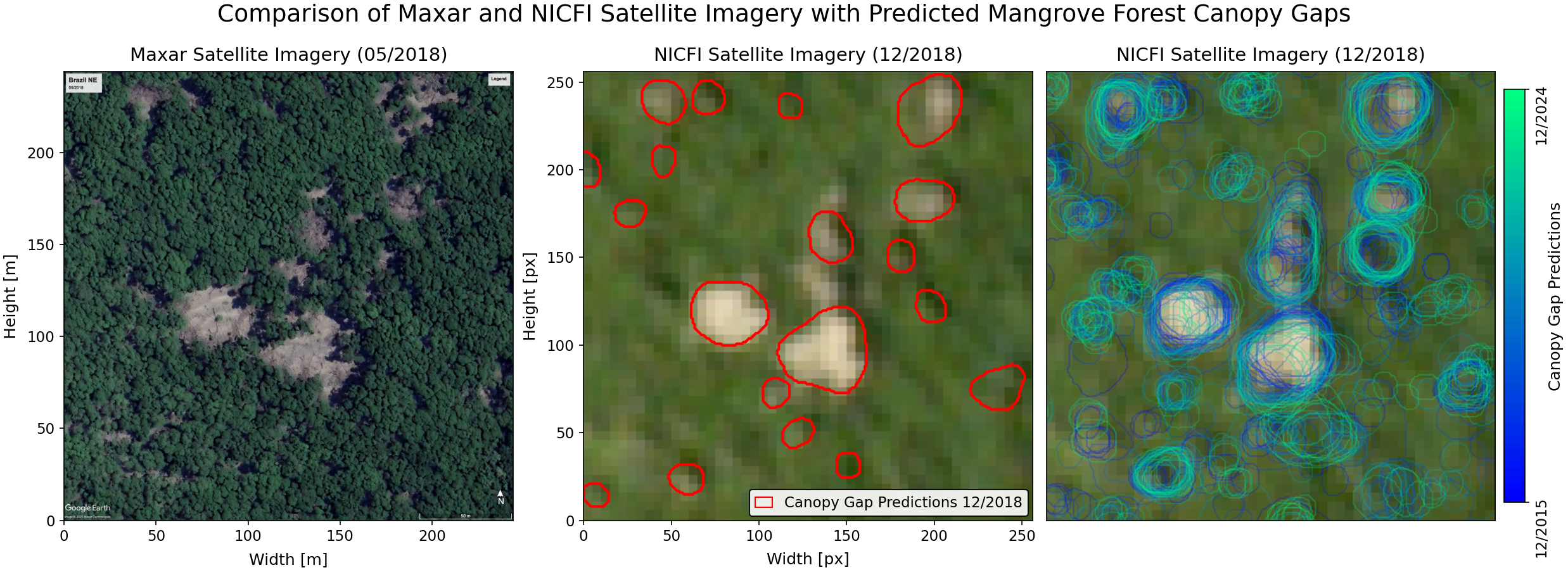
Mapping Gaps in Mangrove Forests Using Deep Learning and Remote Sensing: Correlation Between Gap Frequency and Canopy Height
1University of Oldenburg
2Leibniz Centre for Tropical Marine Research
2Leibniz Centre for Tropical Marine Research
Formation of ephemeral canopy gaps are a recurring phenomena in mangrove forests. They are part of the constant renewal process of the forest, and are caused by natural and anthropogenic disturbances. Lightning strikes are assumed to be a major driver of gap formation, given that taller trees are more probable to be struck and therefore more likely to create canopy gaps. In-situ studies of mangrove forests are challenging given their intertidal environment and remote geographical locations, making remote sensing platforms a promising alternative for research. Previous studies have successfully mapped mangrove canopy gaps using commercial very-high-resolution (0.3m) satellite imagery in combination with machinelearning approaches. However, the high monetary cost of such imagery limits its applicability for large-scale or long-term analyses. In this study, we present a method for mapping mangrove canopy gaps globally and across multiple years using deep convolutional neural networks applied to freely available satellite imagery. We use multispectral satellite imagery provided by the Norway International Climate and Forest Initiative (NICFI), which covers tropical regions at a spatial resolution of 4.77m at bi-annual or monthly intervals. We trained Convolutional Neural Networks (CNNs) with annotated data from worldwide 9 regions. We successfully mapped canopy gaps in sampling sites within each region across 62 time points between 2015 and 2024, achieving a recall of 0.75, and accurately tracking gaps throughout time. We used the resulting gap maps to investigate the relationship between canopy height and gap frequency. We applied Spearman’s rank correlation to assess the relation between canopy height “pre-disturbance” and frequency of gap formation. Afterwards, we conducted a Monte-Carlo test to assess if the observed correlation is due to chance. Based on these tests, we identified significant positive correlations between canopy height and gap frequency in 2 of the 9 study regions.
15:15
Modelling competition for nutrient uptake among diazotrophs of different cell sizes
1Systems Ecology Group, ZMT
2Faculty of Biology & Chemistry, University of Bremen
3Natl. Inst. of Aquatic Resources, Technical University of Denmark
4Graduate School of Oceanography, University of Rhode Island
5Earth System Science, University of California
2Faculty of Biology & Chemistry, University of Bremen
3Natl. Inst. of Aquatic Resources, Technical University of Denmark
4Graduate School of Oceanography, University of Rhode Island
5Earth System Science, University of California
In the surface of the global ocean, inorganic nitrogen limits the growth of phytoplankton, which forms the base of the marine food-web. Although nitrogen is extremely abundant in the form of N2 (dinitrogen), phytoplankton cannot use N2 for growth. Only certain bacteria, called diazotrophs, are capable of converting N2 into a form of nitrogen that can be used by phytoplankton. Also the growth of diazotrophs can be limited by the availability of nutrient and in particular by inorganic phosphorous, which is another essential element for organismal growth. To supplement their growth, some diazotrophs can access an organic form of phosphorous called phosphonate. Here we present a cell-based mathematical model used to investigate the mechanisms driving the success of some diazotrophs such as Trichodesmium (a colonial cyanobacterium, large cell) and UCYN-A (a nitrogen-fixing organelle, small cell) characterised by different size classes under a variety of environmental conditions. Our results suggest that the ability of phosphonate metabolism provides the larger Trichodesmium an advantage over the smaller UCYN-A in environments with low phosphate, especially under high light intensity and high iron concentrations. However, under high phosphate conditions, UCYN-A dominates irrespective of iron concentrations. Our findings are crucial for understanding and predicting marine productivity, ecosystem structure, and marine carbon and nitrogen cycles.
15:30
Acclimatization of corals to global warming: Uncovering the mechanisms of coral-symbiont dynamics
1Faculty of Biology and Chemistry, University of Bremen, Germany.
2Leibniz Centre for Tropical Marine Research (ZMT), Bremen, Germany
2Leibniz Centre for Tropical Marine Research (ZMT), Bremen, Germany
Coral reefs are among the most biodiverse ecosystems on Earth and remain highly vulnerable to climate change. Corals generally host symbiotic dinoflagellates from the family Symbiodiniaceae, which provide photosynthetically derived products that fuels coral metabolism and growth, enabling them to thrive in nutrient poor waters of the tropical oceans. Elevated temperatures can disrupt this partnership by triggering temperatureinduced bleaching, during which corals lose their symbiotic algae and experience substantial physiological stress. However, the physiological mechanisms of how coralsymbiont association changes under increasing temperature and altered light regimes are not well understood. I will present a data-driven mathematical model that we use to examine the changes in coral-symbiont dynamics under varying temperature and light conditions. The model simulates a coral host with a single symbiont type over temperatures ranging from 26 to 30 °C and irradiances from 80 to 360 μmol photons m-2 s-1. At 30 °C, coral and symbiont show the most severe decreases in biomass, 96% and 92%, respectively. These disruptions are accompanied by a 20% increase in symbiont expulsion compared to 26 °C. The decrease in biomass, along with higher symbiont expulsion, indicates substantial weakening of coral-symbiont partnership as thermal stress intensifies. This research provides a basis for understanding the ecological vulnerability of coral reefs under climate change.
15:45
Nearly half the world’s population lives in groundwater risk hotspots
Leibniz Centre for Tropical Marine Research (ZMT), Bremen, Germany
Global assessments of groundwater stress and sustainability have been primarily seen through the lens of the physical balance between withdrawals and renewable resources, depletion, and storage variations. These approaches provide valuable insights into the magnitude and spatial distribution of physical stress on aquifers, but they rarely account for the social, economic, institutional, and governance dimensions that influence how pressures on groundwater resources translate into societal risk. Here, we address this gap by developing the first global groundwater risk framework based on the Intergovernmental Panel on Climate Change (IPCC) AR5 risk concept (IPCC, 2014; Rossi et al., 2023). Groundwater risk is defined as the interaction of three components: hazard, exposure, and vulnerability. Hazard represents the physical imbalance between groundwater recharge and withdrawal; exposure denotes the people, assets, and activities that depend on groundwater resources; and vulnerability captures the socio-economic, infrastructural, and governance conditions that shape societies adaptive capacity. Results show that 48% of the global population resides in groundwater risk hotspots, primarily in South, West, and Central Asia. Lower vulnerability in developed regions partially buffers risk but cannot offset extreme hazard and exposure, leading to persistent hotspots in the Mediterranean and Central North America. Using regionally aggregated risk outcomes, we emphasize the necessity of prioritizing groundwater management. Furthermore, the framework establishes a foundation for enhancing risk indicators and future multi-scale evaluations of groundwater–society interactions.
16:00
TropEcS — A Modelling Perspective on Tropical Coastal Systems
ZMT
The newly established ZMT expansion TropEcS aims to advance our understanding of tropical coastal systems through a comprehensive numerical modelling approach. A key focus is to assess how climate change will affect the highly dynamic tropical environment and the people who depend on it. To address this challenge, we employ a broad suite of modelling approaches, including process models and fully three-dimensional Earth System Models. In addition, we plan to couple the physical and biogeochemical components to models of coastal marine and terrestrial ecosystems to also study social-ecological dynamics and impacts on human societies. By developing and integrating novel modelling frameworks, TropEcS seeks to provide more realistic representations of the drivers shaping tropical coastal systems and assess the impacts of these drivers together with regional partners and coastal communities that depend on them. TropEcS is strongly committed to collaborative knowledge exchange and will foster close partnerships with scientists and local actors in tropical regions. In this presentation, we will outline the first research directions of TropEcS, describe our current modelling strategy, and hope to inspire future collaborations within the rich ZMT research and partnership network. Chaired by Désirée Schwindenhammer and Hauke Kegler Central questions: – Which methods/experiments/partnerships did not work out as planned? – Are there patterns or common pitfalls? – What can we learn for future endeavors? – Where, how, and with whom can we have these conversations? Chaired by Raimund Bleischwitz Excellent! I’m pondering with a small panel at ZAC7 to explore ‘regions as transformative hubs’ – not in isolation but as an interconnected alliance. It plays into restoring our core ecosystems (mangrove forests, reefs), enhancing blue food, and emerging discussions on regional innovation systems and prosperity across countries. Happy to provide an input (as I did for our COP30 workshop) along with a few others. Such panel could either set the scene at the beginning or conclude with an outlook. Best wishes, Raimund ^ ZAC7 Organisation Committee: Cover Photo: xxxxxx Published by: Leibniz Centre for Tropical Marine Research Fahrenheitstraße 6 28359 Bremen, Germany
Navigation:
← Back to Program |
Special Sessions |
Session 1 |
Session 2 |
Session 3 |
Session 4 |
Posters
← Back to Program |
Special Sessions |
Session 1 |
Session 2 |
Session 3 |
Session 4 |
Posters