
ZAC7 Abstracts – Session 4
Middle East, North Africa and South Asia
Tuesday, 27 January 2026
Session 4: Middle East, North Africa and South Asia
Chaired by Cátia Ehlert von Ahn, Sara Galal Abbass Issa Ahmed & Murugan Ramasamy
13:30
Regional Keynote (remote):
Anaerobic microbial processes and environmental factors governing greenhouse gas emissions in coastal sediments of Kerala
14:00
First look at the Last Interglacial central Red Sea coral records as a benchmark for modern warming
1ZMT, Bremen, Germany
2CNR-ISP, Bologna, Italy
3LSCE, Paris, France
4CNR-ISMAR, Bologna, Italy
2CNR-ISP, Bologna, Italy
3LSCE, Paris, France
4CNR-ISMAR, Bologna, Italy
The Last Interglacial (Marine Isotope Stage 5e, ~129-116 ka) was characterized by global mean sea surface temperatures 1-2 °C warmer than pre-industrial, making it a key reference period for assessing modern and future warm-world climate sensitivity. However, the structure of variability and extremes in this period remains poorly constrained, particularly in marginal seas such as the Red Sea, which limits our ability to place ongoing marine heatwaves and bleaching events into a longer-term context. Here, we present the first 80-year-long, sub-seasonally resolved multiproxy coral record from MIS 5e in the central Red Sea, derived from Porites colonies collected from raised reef terraces near Rabigh (Saudi Arabia). The corals are exceptionally well preserved, as confirmed by CT imaging, XRD and microscopy, which document pristine aragonite and clear annual density banding. We combined δ¹⁸O, Sr/Ca, and Li/Mg to characterize seasonal to interdecadal variability in sea surface temperature at a time when background climate was warmer but atmospheric CO₂ remained near pre-industrial levels. Preliminary analyses reveal clear annual cycles and coherent relationships among temperature-sensitive tracers, indicating the high fidelity of the archive in recording MIS 5e climate dynamics in the central basin. These records provide us a preliminary benchmark for modern warming by comparing the amplitude and frequency of reconstructed warm anomalies with satellite-era SST and heatstress observations from the same region, where corals today are close to their thermal limits and bleaching thresholds.
14:15
Geochemical behavior of a subterranean estuary on the east coast of India
1Leibniz Centre for Tropical Marine Research (ZMT), Bremen, Germany
2School of Environmental Sciences, Jawaharlal Nehru University, New Delhi, India
3 Institute of Geosciences, Kiel University, Kiel, Germany
2School of Environmental Sciences, Jawaharlal Nehru University, New Delhi, India
3 Institute of Geosciences, Kiel University, Kiel, Germany
Submarine groundwater discharge (SGD) is an important transport pathway between land and ocean. The term SGD covers a wide range of processes including not only the direct discharge of fresh groundwater, but also diffuse and brackish fluxes through permeable surface sediments. The mixing zone between fresh groundwater and seawater in the coastal sediments forms a subterranean estuary (STE) where chemical elements undergo biogeochemical transformations before reaching the ocean. The aim of the present study is to understand the biogeochemical processes at the STE of a section of the Odisha coast, India. The coast is tidally influenced and the climate is tropical with an annual rainfall of about 1550 mm. Sampling took place in 2024 during pre-monsoon (May) and post-monsoon (October) seasons. Seawater, groundwater and porewater (down to 125 cm) in transects along the coastline in the intertidal zone were sampled. Samples were collected for several parameters including nutrients, major and trace elements and carbon species. The surface seawater and porewaters along the shoreline showed a large difference in salinity values between the two campaigns: during the pre-monsoon, salinities were up to 36 PSU, while after the monsoon, the salinities decreased to a maximum of 30 PSU. During the postmonsoon season, more and lower salinity spots were detected along the coastline, suggesting that SGD is an important phenomenon in the region causing the formation of an STE. Salinity values were positively correlated with the elevation of the beach, and a seepage line indicating the presence of diffuse SGD was found at about 2m above the sea level. The concentration of nutrients in the different systems suggests that STE plays a role in the transport of nutrients towards the sea. Further studies will continue to better understand the final subterranean element fluxes to the coastal waters of this interesting location.
14:30
The Oxygen Minimum Zones (OMZs) in the Indian Ocean
1ZMT
2University of Hamburg, Institute for Geology, Hamburg, 20146, Germany
3University of Sydney, Charles Perkins Center, NSW 2006, Australia.
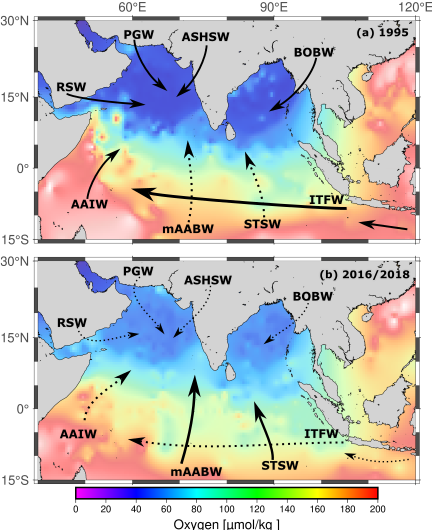
The Oxygen Minimum Zones (OMZs) in the northern Indian Ocean are among the most intense OMZs in the world’s oceans. While there is no clear evidence of a significant change in the Bay of Bengal (BoB) OMZ, the Arabian Sea (AS) OMZ followed the global trend and expanded in the last decades until 2013. Since then, however, this trend has reversed, and the AS OMZ seems to have shrunk. The Changes in these OMZs in response to global warming is poorly understood. In this study we redefined the water masses and employed an extended Optimum Multiparameter (eOMP) Analysis to investigate changes in the oxygen supply due to mixing and biological oxygen consumption dynamics in these OMZs based on empirical field data from the Global Ocean Data Analysis Project version 2 (GLODAPv2) and a research cruise conducted with a German research vessel Sonne in 2024. Our findings reveal in line with previous studies a reversal in the expansion trend of the AS OMZ but also a shrinkage of the BoB OMZ between 1995 and 2016. In both regions this is due to an increased northward influx of oxygen-rich water masses from southern Indian Ocean, combined with a reduced contribution from relatively oxygen-poor local and equatorial water masses. However, we also observed that increased physical oxygen supply was accompanied by an increased biological oxygen consumption. These changes are likely linked to the slowdown of the global thermohaline circulation in the Indian Ocean, which has led to increase in the residence time of water masses in the Indian Ocean. The weaker zonal circulation seems have favored the meridional circulation which carried water from the southern Indian Ocean northwards. This implies a coupling between the OMZ in the Indian Ocean and climate change via the effect of the latter on the global thermohaline circulation.
2University of Hamburg, Institute for Geology, Hamburg, 20146, Germany
3University of Sydney, Charles Perkins Center, NSW 2006, Australia.
The Oxygen Minimum Zones (OMZs) in the northern Indian Ocean are among the most intense OMZs in the world’s oceans. While there is no clear evidence of a significant change in the Bay of Bengal (BoB) OMZ, the Arabian Sea (AS) OMZ followed the global trend and expanded in the last decades until 2013. Since then, however, this trend has reversed, and the AS OMZ seems to have shrunk. The Changes in these OMZs in response to global warming is poorly understood. In this study we redefined the water masses and employed an extended Optimum Multiparameter (eOMP) Analysis to investigate changes in the oxygen supply due to mixing and biological oxygen consumption dynamics in these OMZs based on empirical field data from the Global Ocean Data Analysis Project version 2 (GLODAPv2) and a research cruise conducted with a German research vessel Sonne in 2024. Our findings reveal in line with previous studies a reversal in the expansion trend of the AS OMZ but also a shrinkage of the BoB OMZ between 1995 and 2016. In both regions this is due to an increased northward influx of oxygen-rich water masses from southern Indian Ocean, combined with a reduced contribution from relatively oxygen-poor local and equatorial water masses. However, we also observed that increased physical oxygen supply was accompanied by an increased biological oxygen consumption. These changes are likely linked to the slowdown of the global thermohaline circulation in the Indian Ocean, which has led to increase in the residence time of water masses in the Indian Ocean. The weaker zonal circulation seems have favored the meridional circulation which carried water from the southern Indian Ocean northwards. This implies a coupling between the OMZ in the Indian Ocean and climate change via the effect of the latter on the global thermohaline circulation.
Navigation:
← Back to Program |
Special Sessions |
Session 1 |
Session 2 |
Session 3 |
Session 5 |
Posters
← Back to Program |
Special Sessions |
Session 1 |
Session 2 |
Session 3 |
Session 5 |
Posters